
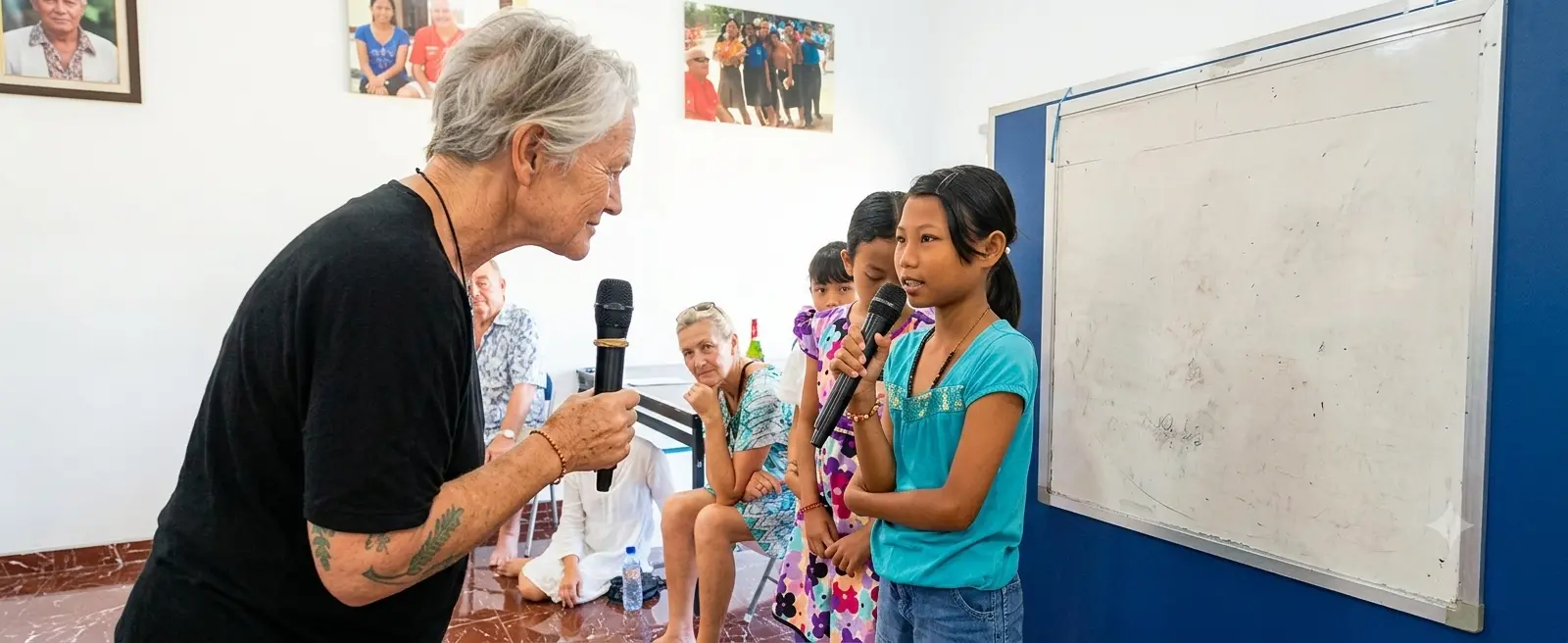
Saturday mornings at Bali Sehat Clinic usually mean patients, blood pressure cuffs, and a quiet waiting room. This week, for a couple of hours, the meeting room turned into something closer to a classroom. Kids from the villages around Amed showed up for Fun English Day, the clinic’s regular English class for children living near the clinic.
Today’s session was run by two volunteers, taking turns leading drills, vocabulary games, and the part the kids clearly look forward to most: passing the microphone around so each child gets a turn to introduce themselves or answer a question in front of the group. In one corner, a girl in a flower-print dress stood holding a worksheet and a pencil, waiting her turn while a classmate finished writing on the whiteboard. A few minutes later, a different group of four girls lined up together, one holding the mic, the others leaning in and pointing at the answer.
Not every kid wants to go first. You can see it in the photos: arms crossed, eyes on the floor, clearly working up the nerve. Then a minute later, that same kid is the one holding the mic. That’s more or less the whole point of the program. It’s not really built around grammar drills. It’s a low-stakes place for a child who’s nervous about English to try it out loud, with people around her who are rooting for her either way.
For Bali Sehat, this sits next to the medical work even though it doesn’t involve a stethoscope. Kids who get comfortable speaking English have an easier time later, in school, with visiting volunteers, with whatever comes after Amed. The clinic runs Fun English for the same reason it runs free maternity care: because what a family in this part of Karangasem can access shouldn’t depend on how far they can travel or what they can afford.
By the end of the session, the room went back to looking like a meeting room again, chairs stacked, whiteboard half wiped clean. For an hour or two though, it had been something else.
Support Bali Sehat Clinic
Programs like Fun English Day run on volunteer time and clinic resources that come directly from donor support. If you’d like to help keep classes like this one running, or support the clinic’s broader work in Amed, you can reach out directly.
No responses yet